Sustainability + Energy Efficiency for Habitat for Humanity
This sample is an adapted version of a strategic plan proposal aimed at persuading the organization’s Board of Directors to approve funding and strategic planning related to growing Habitat’s involvement in the sustainable energy space.
Investing in Energy Efficiency and Sustainability in Affordable Homeownership
Introduction
In 2023, Tacoma Habitat broke ground on its first Carbon-neutral housing development in Gig Harbor. By partnering with Build with Strength, Solid Carbon, and the National Ready-Made Concrete Association, Habitat built the homes using Insulated Concrete Forms that safely sequester Carbon into the concrete walls of the home. In so doing, Tacoma Habitat put itself on the map as an innovator and leader in sustainable housing practices, giving itself real momentum in not only the affordable housing space, but also in the energy and sustainability policy circles. Investing in energy efficiency and sustainability in affordable homeownership broadens Tacoma Habitat’s appeal among legislators and grassroots communities, stretching into new spheres of influence. Energy advocacy opens up myriad new funding opportunities, grant programs, and tax credits. And at a time when climate change is accelerating at an unprecedented speed, this investment is how we live out our value of stewardship: “We are responsible to our community and accountable to our donors, partner families, and volunteers to achieve excellence through the efficient use of our resources.”
Background
Now more than ever, the cost of energy is rising to burdensome levels for more and more of our community. According to FindEnergy.com, the average energy cost of a homeowner is over $100 a month. Washington state ranks third in the country for renewable energy production, yet the costs of upgrading appliances and energy systems, such as solar panels and heat pumps, to support them remain prohibitive, especially to low-income homeowners. This is supported by the National Renewable Energy Laboratory report entitled, “Millions of Homes Can Benefit Today, but Installation Costs Keep Technology Out of Reach for Some.” The study found that up to 95% of homes could see reductions in their energy bills by switching to heat pumps, and they could cut their gas consumption by 41-52%. If implemented nationally, NREL projects that heat pumps would cut residential greenhouse gas emissions by 36-64%.
Tacoma Habitat currently installs heat pumps in all of our new construction projects and many of our home preservation projects. To install a heat pump during a renovation costs Tacoma Habitat approximately $7000; installing the entire system in a new home can range from $10,000-$15,000 per unit. Heat pump water heaters cost about $2000 to install. Based on these prices, we can see the approximate cost of installing energy efficient appliances in all Habitat homes for one year:
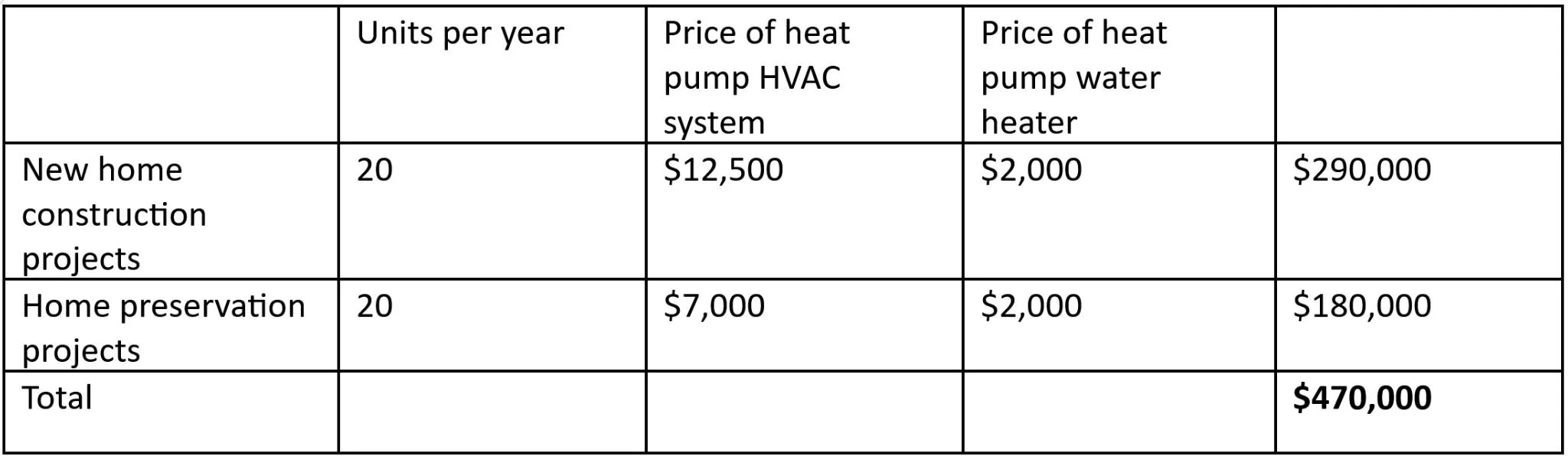
This table exclusively represents heat pumps and shows potential savings of nearly half a million dollars annually.
We provide other sustainability-related services as well, ranging from installing Energy Star refrigerators and dishwashers to providing HRV/ERV whole house ventilation systems to developing stormwater facilities. Other smaller grant programs and loan funds are available to finance these services, explored in depth below.
Current State Law and Constraints
Residential buildings in Washington must comply with the Washington State Energy Code (WSEC), which is based on the International Energy Conservation Code (IECC) with state-specific amendments.
Insulation Requirements: The WSEC mandates minimum insulation levels for walls, roofs, floors, and foundations to improve thermal performance and reduce heat loss or gain in residential buildings, tailored to Washington's climate zones.
Efficient Windows and Doors: The code specifies requirements for windows and doors, including U-factor, SHGC, and air leakage standards, to promote the use of energy-efficient glazing and sealing techniques suitable for Washington's climate conditions.
HVAC Systems Efficiency: Minimum efficiency ratings for HVAC systems are outlined in the WSEC, encouraging the use of high-efficiency equipment and proper sizing to optimize energy performance while considering regional climate considerations.
Lighting and Appliance Efficiency: Requirements for energy-efficient lighting fixtures and appliances, such as Energy Star-rated products, are enforced to reduce electricity consumption in residential buildings throughout Washington.
Air Leakage Control: The WSEC includes provisions for air sealing measures to minimize unintended air leakage, improving indoor air quality and reducing heating and cooling loads in compliance with Washington's energy efficiency goals.
Duct Sealing and Insulation: Ductwork sealing and insulation requirements are specified to prevent energy losses and ensure efficient distribution of conditioned air, tailored to the climate and building practices prevalent in Washington state.
Renewable Energy Integration: While not mandated, the WSEC may incentivize or provide guidelines for the integration of renewable energy systems like solar panels or geothermal heat pumps to supplement conventional energy sources and reduce environmental impact.
Compliance and Enforcement: Washington's energy codes are enforced through inspections and certifications to verify compliance with the WSEC, with penalties for non-compliance and restrictions on occupancy until code requirements are met.
Continual Updates and Adaptations: The WSEC undergoes periodic updates to incorporate advancements in building technology, changes in energy efficiency standards, and emerging environmental priorities, requiring developers in Washington to stay informed and adjust their practices accordingly.
Homeowner benefits
Always central to Tacoma Habitat’s work is our partner families. So, how can investing in advocacy around energy efficiency and sustainability benefit low- and mid-income homeowners?
There are significant cost savings to the homeowner associated with energy efficiency. Some estimates from the National Renewable Energy Laboratory indicate simply switching to an HVAC heat pump could result in median savings of $300 to $650 annually.
Engaging with Departments of Ecology/Environmental Resources/etc. has the potential to open up new opportunities to apply for direct assistance programs on behalf of or with our homeowners. Building these relationships could also result in direct allocations from departmental budgets or the State Capital Budget, ultimately subsidizing the cost of the home and lowering the monthly payment of homeowners.
Growing Habitat’s resources to provide high-quality, energy-efficient, cost-saving appliances to homeowners both in new construction and renovations has a direct impact on the homeowner. For the subsidized price of their home, they will also receive top-of-the-line appliances that Habitat doesn’t have to pay for.
We could potentially expand the impacts of these programs to include the Aging in Place programs, positioning ourselves to receive more Weatherization Assistance funding by making ourselves a known entity among the departments and groups that disburse these funds.
Federal Policy Overview: Climate Commitment Act
The Climate Commitment Act is a policy aimed at combating climate change by implementing a cap-and-trade program for greenhouse gas emissions in Washington State. Enacted in April 2021, it sets ambitious targets for reducing emissions across various sectors, including residential development.
One key aspect of the Climate Commitment Act is its focus on reducing emissions from buildings, including residential properties. This is significant because buildings, including homes, account for a substantial portion of greenhouse gas emissions due to energy consumption for heating, cooling, and electricity.
The Climate Commitment Act may affect residential development:
Energy Efficiency Standards: The Act is likely to impose stricter energy efficiency standards for newly constructed residential buildings. This could include requirements for better insulation, energy-efficient appliances, and the use of renewable energy sources such as solar panels.
Emissions Reduction Targets: Residential developers may face targets or quotas for reducing carbon emissions associated with the construction and operation of their buildings. This could incentivize the use of low-carbon building materials and technologies.
Incentives for Sustainable Development: The Act may provide financial incentives or tax breaks for residential developers who incorporate sustainable design principles into their projects, such as passive heating and cooling, rainwater harvesting, and green roofs.
Transportation and Land Use Planning: The Act may also influence residential development patterns by encouraging denser, mixed-use developments that reduce the need for car travel and promote walking, cycling, and public transit. This can help lower emissions associated with transportation.
Overall, the Climate Commitment Act is likely to significantly impact residential development in Washington State by promoting more sustainable and energy-efficient building practices, reducing carbon emissions, and fostering a shift towards more climate-resilient communities.
Federal Policy Overview: Inflation Reduction Act
The Inflation Reduction Act (IRA), enacted in 2022, has significant implications for both residential development and climate-focused initiatives. Impacts include:
Residential Solar Projects: The Biden-Harris Administration recently announced the $7 billion Solar for All Grants program. This initiative aims to deliver residential solar projects to over 900,000 households nationwide. Funded through the Inflation Reduction Act, this program will provide grants to states, territories, Tribal governments, municipalities, and nonprofits. Its goal is to enable low-income and disadvantaged communities to benefit from distributed residential solar, thereby lowering energy costs, creating jobs, advancing environmental justice, and addressing climate change.
Commercial to Residential Conversions: The Inflation Reduction Act also unlocks financial resources for commercial to residential conversions. These funds make such conversions more financially viable and contribute to achieving zero emissions in buildings.
Residential Energy Efficiency and Electrification: The IRA allocates $9 billion for residential energy efficiency and electrification programs. These programs include consumer rebates and funds for technical training, aiming to enhance energy efficiency and promote electrification in residential buildings.
In summary, the Inflation Reduction Act plays a crucial role in advancing sustainable residential development, promoting clean energy, and ensuring equitable access to solar power for all.
Funding Opportunities
High-Efficiency Electric Home Rebate Act (HEEHRA)
Washington has been allocated $82,782,050
Home Energy Performance-Based Whole-House Rebate Allocations
Washington has been allocated $83,266,580
Home Electrification and Appliance Rebate (HEAR)
Eligible 501c3s
Qualifying equipment: heat pumps, induction cooking, heat pump water heaters, heat pump dryers, electric panel and wiring upgrades required to accommodate new electric equipment
15% can be used for administrative expenses
Not subject to prevailing wage requirements
Clean Water State Revolving Fund
Funds nonprofits
Funds green and gray infrastructure stormwater projects
“CWSRF programs may now provide financial assistance for measures to manage, reduce, treat, or recapture stormwater or subsurface drainage water. Publicly and privately owned, permitted and unpermitted projects that manage, reduce, treat, or recapture stormwater or subsurface drainage water are eligible. This language eliminates ownership constraints on regulated stormwater projects. For example, projects that are specifically required by a Municipal Separate Storm Sewer System (MS4) permit are now eligible, regardless of ownership. Projects may include, but are not limited to green roofs, rain gardens, roadside plantings, porous pavement, and rainwater harvesting (section 603(c)(5).”
“Financial assistance for the development and implementation of watershed projects in one of the six areas: watershed management of wet weather discharges, stormwater best management practices, watershed partnerships, integrated water resource planning, municipality-wide stormwater management planning, or increased resilience of treatment works. Assistance recipients may be public or private entities (section 603(c)(7)).”
“financial assistance to any qualified nonprofit entity, as determined by the Administrator, to provide assistance to owners and operators of small and medium publicly owned treatment works (A) to plan, develop, and obtain financing for eligible projects, including planning, design, and associated preconstruction activities; and (B) to assist such treatment works in achieving compliance with this Act. Projects to provide assistance to small and medium POTWs are eligible. The definition of small and medium POTWs shall be determined by the state. Assistance recipients must be a nonprofit entity. A nonprofit entity is one which has Federal tax-exempt status. The CWSRF cannot fund ongoing O&M activities; however, planning, design and construction costs for capital projects, as well as broader water quality planning projects, are eligible. The development and initial implementation of training activities are also eligible…”
Washington State Department of Ecology: Stormwater Capacity Grant programs: Stormwater capacity grants program - Washington State Department of Ecology
Stormwater capacity grants: city and county
Stormwater financial assistance programs
Greenhouse Gas Reduction Fund Programs
Clean Communities Investment Accelerator
EPA will award grants of $6 billion total to 2 – 7 national nonprofit organizations (grantees). Grantees, in turn, will make capitalization grants of up to $10 million to community lenders to be used as loan capital. It bears emphasizing that it is our understanding that national organizations will provide no-costs grants of up to $10 million to community lenders. Community lenders in turn will use those funds to provide financial assistance (lend) to projects in their communities. Grantees will also award technical assistance grants of up to $1 million, and provide technical assistance services. It is our understanding that national organizations plan to tailor the amount and timing of capitalization grants (up to $10 million) and the technical assistance grants (up to $1 million) based in part on what community lenders want and need. Lenders with experience with climate-related finance could be expected to receive more funds as capitalization grants, while lenders with less experience could receive technical assistance grant to allow them to build their capacity for future capitalization grants. Technical assistance and training will be designed to help community lenders apply for funds through National Clean Investment Fund (described in the next section). The entire amount must be expended in low-income and disadvantaged communities (per the law). Justice40 also requires 40% of funds to benefit low-income and disadvantaged communities. The period of performance is six years.
https://www.epa.gov/greenhouse-gas-reduction-fund/clean-communities-investment-accelerator.
National Clean Investment Fund
EPA will award grants of $14 billion total to 2 – 3 national nonprofit organizations (grantees). Two billion dollars of this must be spent in low-income and disadvantaged communities. Grantees, in turn, can directly invest in projects or invest indirectly through community lenders. Justice40 also requires 40% of funds to benefit low-income and disadvantaged communities. The period of performance is seven years. EPA did not set at cap on the amount of funds that could be invested in NCIF. NCIF is also intended to be a source of funds to community lenders funded through CCIA. Funds through the NCIF will be lent to projects and community lenders, meaning there will be a cost to this capital for community lenders that may affect our ability to finance projects within our communities. As of January 2024, we have not learned specifics regarding the cost of capital. However, national organizations have indicated they will keep the cost of capital low in order to meet the requirement to reaching low-income and disadvantaged communities across the country.
https://www.epa.gov/greenhouse-gas-reduction-fund/national-clean-investment-fund
Solar for All (SFA)
EPA will make grants available for (1) all U.S. states and territories, (2) Indian tribes, and/or (3) coalitions representing cross-state geographies for up to $7 billion total.
https://www.epa.gov/greenhouse-gas-reduction-fund/solar-all.
Solution & Strategy
Objective: Access funding through public entities and enact policy changes to fund energy efficiency upgrades.
Strategy
Strategy 1: Identify and obtain new sources to fund energy efficiency appliance installation and upgrades in our projects.
Work with the Washington State Department of Commerce to influence the implementation of the Inflation Reduction Act.
Ensure that Habitat, or “permanently affordable homeownership providers” more broadly, are explicitly defined as housing “aggregators,” allowing us to tap into funding that would otherwise be limited to individual low-income homeowners.
Establish presence/influence within the Department of Commerce’s Energy Office, ensuring that the needs of low-income homeowners are represented and that Habitat is at (or close to) the table when major structural decisions about the IRA are taking place.
Identify other Habitat affiliates that have been successful in their efforts to shape their state’s IRA funding response.
Utilize the collective knowledge of the HFHI network to identify federal energy funding opportunities.
Identify state and local groups that may provide assistance, such as USDA, sustainability organizations, etc.
Strategy 2: Identify and obtain new benefits for homeowners that could result in the lowering of their monthly energy payments.
Work with TPU, Elmhurst, and PSE on the provider side to connect Habitat homeowners with existing assistance programs.
Advocate for the continued inclusion (and associated cost of living increases) of energy assistance funding for low-income homeowners at the municipal and state levels.
Strategy 3: Identify and advocate for policy changes that will increase funding available for sustainable housing projects and energy efficiency efforts.
Establish a long-term statewide revolving fund or grant program to support residential energy efficiency upgrades.
Provide state-, county-, or city-level tax incentives or rebates to developers that outfit homes with energy efficient appliances.
Take a more prominent stance “pro” toward Transit-Oriented Development, solidifying our place in the policy conversations at the intersection of sustainability and affordable housing.
Advocate for the inclusion of energy efficiency considerations in Comprehensive Planning processes in municipalities.
Advocate for set asides in city, county and state budgets for energy efficient appliance retrofits and installs in affordable housing.
Strategy 4: Leverage our new policy affiliation with energy efficiency to engage new lawmakers with special interests in energy efficiency.
Identify and meet with lawmakers to signal our intent to focus advocacy resources into energy efficiency for affordable housing.
Identify which lawmakers might champion our causes or sponsor bills on our behalf.
Identify lobbyists that can specialize in helping us make introductions to lawmakers with interests in environmental causes and energy efficiency.
Strategy 5: Utilize our newfound standing in the sustainability and energy efficiency space to broad our base of supporters and activate a larger grassroots network of advocates.
Include efforts in communications and marketing materials to get the word out.
Publish blog posts about our efforts in the energy efficiency space.
Publish educational content showing community members how to tap into low-income energy efficiency rebates for their own benefits.
Hold seminars on topics like energy assistance, energy efficiency, and the importance of considering sustainability in affordable housing.
Identify three to five community members who are especially passionate about this work and mobilize them to engage with elected officials on Habitat’s behalf.
Strategy 6: Expand efforts to include all housing production areas, such as AIP, new home construction, and home preservation.
Engage in conversations with established connections about the possibility of funding energy efficiency upgrades in the homes of our AIP and CRH clients.
Engage in conversations about setting up a long-term fund to sustain Habitat’s HHP program, seeking to preserve existing affordable housing.
Continuously seek out new energy-related funding sources by tracking energy legislation at all levels of government.
Identify partners who may have access to multiple homes that could be preserved at a time—such as banks (foreclosures), cities (derelict properties), housing authorities (divestments), etc. and cultivate preferred bidder relationships with these organizations to sustain our Habitat Home Preservation (HHP) department after the conclusion of the PCHA project.
Connect this work with our partners in HFHI advocacy to establish larger-scale partnerships between Habitat and other national/international organizations that could provide resources (homes or funding) for major preservation projects.
Explore opportunities to incorporate aspects of manufactured housing that could make our production more efficient.
Strategy 7: Identify private foundations with special interest in sustainability and cultivate their support.
Expand our scope of private foundation support by researching and identifying new partners that have funding for sustainability efforts.
Develop communications materials like one-pagers and short presentations that present a solid narrative regarding Habitat’s solution of building high-quality, energy-efficient affordable housing while still upholding, and even exceeding, sustainability standards.
Strategy 8: Capitalize on all aspects of our investment in sustainability through creative marketing strategies to tell a story about a concerted transition of emphasis onto sustainability.
Engage representatives in each department to think creatively about the ways their department does and could invest in sustainability more heavily.
Highlight the importance of the Habitat Stores in our sustainability efforts.
Highlight paint care program.
Use statistics illustrating the real impact the Store is having on sustainability (e.g., “Habitat Stores diverted x tons of waste from landfills in 20xx.”)
Encourage volunteering and shopping at the store to drive engagement with sustainability initiatives among a different demographic group (shoppers vs. donors, etc.)
As our influence in sustainable retail grows, identify new commercial partners that might be interested in being associated with our new brand of sustainability.
Explicitly identify our HHP project in partnership with PCHA as a sustainability push – stock preservation rather than new construction.
Engage social media managers to communicate this information to a wider network.
Future Collaboration Possibilities
Potential State Lawmakers
Sharlett Mena (Vice Chair of Environment & Energy Committee)
Jake Fey (on E&E, champion for transit and environment issues)
Melanie Morgan (Vice Chair of Ag & Natural Resources Committee)
Yasmin Trudeau (on Environment, Energy and Technology in the Senate, very interested in housing--work the housing and environment intersection)
Ways and Means and Appropriations members—anything in State Legislature on these fronts will likely need a fiscal note, so we need to continue to cultivate our budget influencers to make decisions that benefit Habitat.
Department of Natural Resources
With DNR and SPS Habitat recently passing a law allowing DNR to lease their land to affordable housing providers, there is momentum around the intersection of affordable housing and natural resources. DNR is actively looking for input on how to implement and incentivize affordable housing—and specifically homeownership—construction on public lands.
We should remain engaged in this process and use DNR’s reputation and interest in affordable homeownership partners to bolster our reputation in the environmental/energy efficiency policy space. DNR is a much bigger deal in those conversations than Habitat, generally speaking.
Departments of Ecology, Environmental Services, etc.
Build relationships among municipal and state environmental services buildings to cultivate their knowledge of Habitat-specific concerns and interest in developing program suited specifically to our organization’s needs.
Russell Family Foundation: specifically interested in supporting climate change/sustainability efforts
Resources
Habitat Solar for All Subrecipient Value Case-Guide.docx (sharepoint.com)
National Renewable Energy Laboratory
Stormwater capacity grants program - Washington State Department of Ecology
https://www.epa.gov/greenhouse-gas-reduction-fund/clean-communities-investment-accelerator.
https://www.epa.gov/greenhouse-gas-reduction-fund/national-clean-investment-fund
https://www.epa.gov/greenhouse-gas-reduction-fund/solar-all
Conclusion
For years, Tacoma Habitat has been going above and beyond state and federal energy codes and requirements to provide excellent products in the homes of each Habitat homeowner. With the federal and state governments’ recent postural changes toward energy efficiency, sustainability, and affordable housing, there are a variety of new public funding sources for specific products and services that our organization currently provides at our own expense.
Tacoma Habitat has been given a unique opportunity to jump into this space at a time when our sustainability-related initiatives have recently materialized (Canterwood, Stores, PCHA, etc). The momentum is growing, and the time is right in politics: as concerns over climate and affordable housing grow, there are more and more thinkers and leaders looking for mutually beneficial solutions to avoid pitting these two interest areas against one another. Because of its brand and efforts laying the foundation, Habitat has an opportunity to be on the vanguard of these new policies and program designs.
By investing our advocacy efforts in policy changes around the emerging interest of lawmakers in sustainability and affordable housing, Tacoma Habitat stands to not only make a positive impact on our environment by continuing to cut greenhouse gases, preserve clean water supplies, and provide comfortable, affordable energy services to our clients, but also tap into a large and growing new suite of funding opportunities around sustainability in housing.
In short: there’s money on the table and a hunger to invest it in sustainable affordable housing. Let’s make Habitat a—if not the—leader in that space by using our resources to proactively pursue those benefits while also increasing the positive impact we have on our community.